 By Gianluca Mezzofiore | IB Times – 22 hours ago
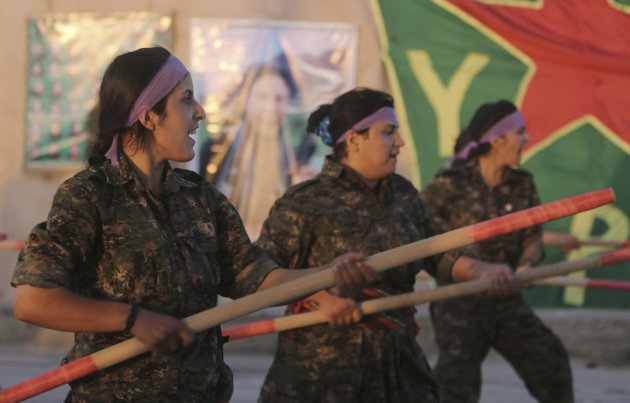
- View PhotoIB Times/Gianluca Mezzofiore - Kurdish female fighters of the Women's Protection Unit (YPJ) participate in training at a military camp in Ras al-Ain city in Hasakah province
The
suicide attack of a Kurdish female fighter who blew herself up in
Kobani killing several Islamic State (also known as Isis) militants has
put the spotlight on the Yekineyen Parastina Jin or Women Protection
Units (YPJ) at the frontline of the battle against jihadists.
Dilar Gencxemis, known by her nom de guerre Arin Mirkan, was a
20-year-old mother of two who detonated herself as she ran towards Isis
fighters, killing as many as 23 of them. As urban guerrilla warfare
starts on the streets of Kobani, on the Turkish-Syrian
border, Kurdish resistance is increasingly relying on its female
fighters to save the town on what appears as a desperate fight for
survival.According to various estimates, female fighters make up between 7,000 and 10,000 of the Kurdish forces fighting in Syria. The YPG is an all-female, independent militia which at the frontline embrace arms along with their male "comrades" of the YPG, the People's Protection Units.
Linked to the Marxist-inspired Kurdistan Workers' Party (PKK), an outlawed organisation blacklisted in the US and the EU who fought the Turkish army for 30 years causing 40,000 deaths, the YPG is desperately outnumbered and outgunned by Isis, which boasts an arsenal of US weapons looted from the Iraqi army in Mosul.
But the YPG can still count on the ideological fervor driving many Kurdish volunteers across the Turkish border to join them against Islamists. Last week, it was reported that a 19-year-old female fighter, named Ceylan Ozalp, killed herself with the last bullet rather than falling into the hands of Isis. The news was not confirmed by Kurdish media, but pictures of the young, defiant fighter went viral on Kurdish accounts, with many hailing her as a heroine.
"When they see a woman they run away"
Ozalp, also known as Diren, was pictured in a BBC video service defiantly saying: "We're not scared of anything. We'll fight to the last. We'd rather blow ourselves up than be captured by Isis".
She went on claiming that when Islamists see a woman with a gun "they're so afraid the begin to shake". They portray themselves as tough guys to the world. But when they see us with our guns they run away. They see a woman as just a small thing. But one of our women is worth a hundred of their men," she said.
Her statement plays into the common belief shared by Isis fighters that they will not go to paradise if they are killed in battle by a woman. But feminist ideology has always been part of the Kurdish fighting movement.
One of the founding members of the PKK was Sakine Cansiz, who was shot dead along with other two younger female activists in the office of the Kurdish information centre in Paris, in 2013. The exact number of PKK female fighters who chose to leave their families and join the guerrilla in the harsh mountains in Qandil is unknown, but it has become a standard phenomenon.
In the political doctrine of the imprisoned leader of the PKK, Abdullah Ocalan, women and men play an equal role in society and no society can be free without the freedom of women. Drawing inspiration from Kurdish history as well as Marxism, Ocalan sees the empowerment of women as a way to get rid of the patriarchal thinking that marred racist and sexist societies. Fighting, in the PKK ideology, is a physical as well as an intellectual exercise.
Many Kurdish women who joined the ranks of the PKK did so to escape social conservatism, honour killings, domestic violence and lack of opportunities for women, according to Jenna Krajeski, who wrote an insight into Kurdish female fighters in The Atlantic. "A revolution holds much promise, particularly for women. They participate for two reasons -- as a member of an oppressed society, and as oppressed people within that society," she wrote.
Related articles : Syria Isis News: Female Kurdish Suicide Bomber 'Kills Dozens of Islamic State Militants' in Kobani
Syria: Isis Jihadis Terrified of Fanatical Kurdish Women Soldiers who will Deny Them Place in Paradise Related video
Best of Yahoo News


Editor's Picks
1 - 4 of 36
Featured videos
 2:02
2:02Morocco Jail Ordeal 'Horrendous'
- 8:36
Cannabis Head To Head: The Sky News Debate
- 0:19
Strange Spider Teases Then Leaps Onto Terrified Man
- 2:27
The rest of Wednesday's Forecast
- 3:00
Fear Over Scale Of Sexual Abuse
- 2:36
UKIP To Bruise Labour And Tories
- 1:16
Underwater classroom: Professors spend 73 days under sea
- 2:46
Leading virologist: UK is prepared for ebola outbreak
- 1:37
Joy Of Womb-Transplant Baby Parents
- 3:05
How Popular Is Putin In Russia?
- 1:15
Boris forgets name of Tory Clacton candidate
- 1:58
Compassion Urged For Self-Harmers
Today on Yahoo
1 - 8 of 45
News for you
Typhoon Vongfong Becomes 2014's Most Powerful Storm
16 hours ago
Samsung expects lowest profit in over 3 years
20 hours ago

LED inventor feels work bypassed by Nobel
11 hours ago
Skeleton of Medieval 'Witch Girl' Found Buried Face Down in It …
Mon, Oct 6, 2014


 God
wants your family to succeed and prosper, and He has given you the
blueprint to make your family's happiness possible! The Bible contains
rock-solid principles upon which you can build a strong family.
God
wants your family to succeed and prosper, and He has given you the
blueprint to make your family's happiness possible! The Bible contains
rock-solid principles upon which you can build a strong family. Did
you know that the span of the great Gold Gate Bridge in San Francisco,
California, will sway as much as 20 feet? The two towers of that bridge
are solidly anchored, yet the suspended bridge can move a little and
still maintain its strength.
Did
you know that the span of the great Gold Gate Bridge in San Francisco,
California, will sway as much as 20 feet? The two towers of that bridge
are solidly anchored, yet the suspended bridge can move a little and
still maintain its strength. There
are three important truths in Psalm 127 about the happiness children
bring to the home. First, children are desirable. Psalm 127:3 says,
"Children are an heritage of the LORD and the fruit of the womb is his
reward."
There
are three important truths in Psalm 127 about the happiness children
bring to the home. First, children are desirable. Psalm 127:3 says,
"Children are an heritage of the LORD and the fruit of the womb is his
reward."


